
From Idea to
Publication
Author Submission Guidelines: Here's everything you need before you click submit

Who Can Submit?
Whether it is your first paper or a creative project, your voice matters.

Class 9-12 students
School authors from any stream.

Undergraduates
All disciplines welcome.

Open Access
Your work is free to read, forever.
iNextResearcher invites school and undergraduate students to submit original research and creative work that reflects critical thinking, curiosity, and ethical scholarship.
We invite students to share their original ideas, projects, and discoveries with a wider academic community. Our platform is designed to encourage young researchers to explore, question, and contribute across disciplines. These guidelines will help you prepare your submission in a clear, professional, and impactful way so that your work can shine and inspire others.
iNext is all about curiosity, joy of learning, and the thrill of exploring new horizons.
Our goal is to provide a credible, ethical platform for young researchers to explore, express, and excel.
Journal Format & Frequency

Volume
One per year • Start: 2025

Issues
April • August • December

Language & Format
English • Online (Open Access)
What Makes a Strong Submission?

Originality
Your own ideas &
interpretation.
Clarity
Clear goals,
methods, results.
Ethics
Cite properly &
acknowledge.
Reflection
Show your
thought process.
Responsible AI
Assist for grammar;
never author.
What You Can Submit


Research Papers

Original Research
Present new discoveries or findings from your study.

Case Study
Share an in-depth look at a single project, or event.

Commentaries
Offer your insights on current issues or research.

Comparative Studies
Explore similarities and differences between ideas.

Review
Summarize and evaluate existing research field.

Perspectives/Opinions
Express your personal or professional viewpoint.

Critical Analysis
Provide a deep evaluation texts, theories, practices.

Social Impact Research
Research that addresses social issues and solutions.

Multimedia Research
Use video, audio, or visuals to support your research.

Innovation & Design
Highlight creative solutions, products, or designs.

Future Enquiry
Imagine possibilities and explore future scenarios.

Cross-Field Project
Blend multiple fields to create fresh insights.
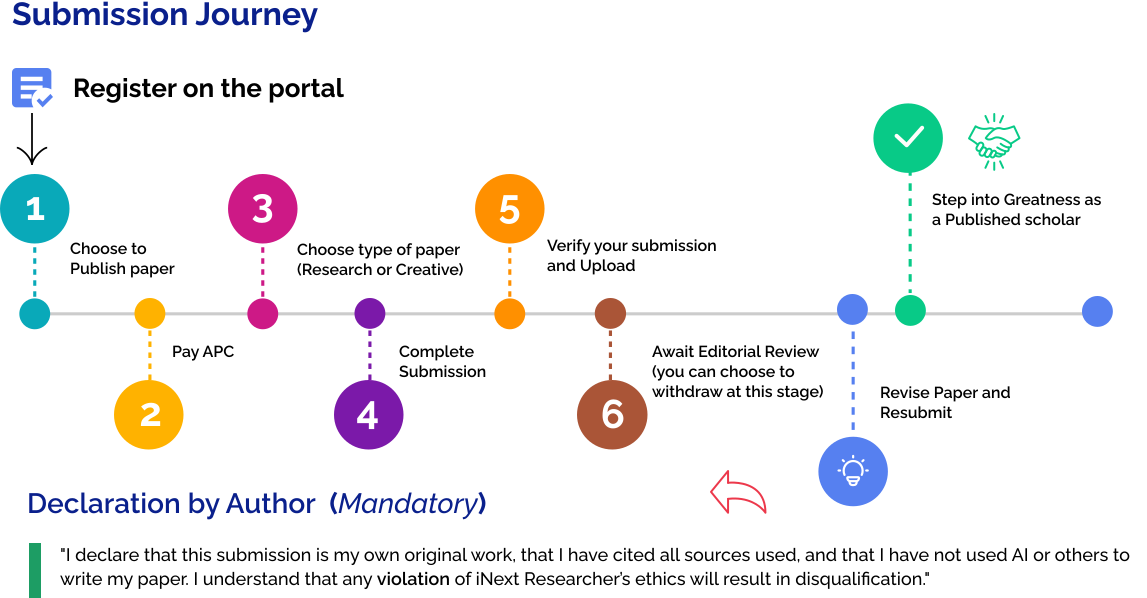
Publication Process

Creative Writing

Fiction
Tell imaginative stories that captivate readers.

Non-Fiction
Share real-life experiences, reflections, or factual writing.

Poetry
Express ideas and emotions
through rhythm and verse.
Structure of the Article
Research Paper

- Title and Subtitle
- Abstract (150 - 500 words)
- Introduction
- Methodology (if applicable)
- Findings or Analysis
- Discussion and Conclusion
- References or Bibliography
Creative Writing Paper
- Title and Subtitle
- Abstract (150 - 300 words)
- Introduction (theme & inspiration)
- Concept & Approach
- Main Work (story, poem, essay extract)
- Reflection or Analysis
- Inspirations (if any)
Research Ethics & Academic Integrity
- No plagiarism – Your Work Must Be Original.
- No ghostwriting or AI-written papers (AI may assist, not author).
- Cite all sources (URLs, DOIs, books, articles).
- If using surveys or interviews – get consent & protect privacy.
- Automatic rejection – Fabricated data or AI misuse.

What Not to Do
- Copy-paste from online sources without proper citation
- Fabricate or manipulate data, results, or references
- Submit someone else's work as your own
- Use AI to write or rephrase your submission
- Forget to acknowledge collaborators or co-authors
- Submit incomplete, poorly formatted, or draft-quality work
- Submit to multiple journals at once
- Ignore feedback and resubmit unchanged work
- Use offensive, discriminatory, or inappropriate language
- Add images, charts, or media without permission or citation

Submission Checklist
We understand preparing your article can feel like a big task. To make it easier, we've put together a simple checklist.
This guide highlights the key points you should review—what to include, what to double-check, and what to keep in mind—so your submission is complete and ready to shine.
Download our submission checklist pdf
Make your work discoverable and remembered
Big ideas don't wait–neither should you
 Publish with iNextResearcher