We'd appreciate your feedback
Mission Hero
Open Access For Students

Research Categories

Publish meaningful research. Create impact.
Publish your first paper today.

Research at iNext: Where Curiosity Meets Creativity

Choose Critical Analysis

Choose Comparative Study

Choose Case Study

Choose Original Research Article

Choose Review Paper

Why It Matters

At iNext Researcher, we believe research is more than just experiments or academic papers. It's about asking questions, exploring passions, and creating something meaningful. Whether you are discovering science, interpreting history, or writing creatively—your research matters.

Our platform welcomes two main types of research from students: Academic Research Papers and Creative Research. We use a state-of-the-art automated submission platform that automatically formats and structures your submission to meet professional publishing standards.
Student with science model

Types of Research

Academic Research Papers

For students who want to explore real-world questions through analysis, experimentation, or investigation.

Original Research Articles

Do you want to try something new? This type of research
is about discovering or testing ideas through experiments,
surveys, or fieldwork.

Example: Building a small water filter or testing which study
methods help students focus better.

Case Studies

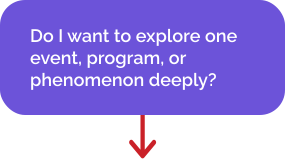
Here, you study one example in depth—like a school, city,
or person—to understand what makes it special or how it
works.

Example: How one school manages waste or how a café
became eco-friendly.

Critical & Review Papers

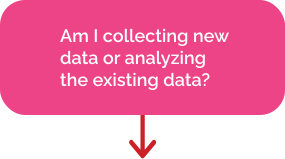
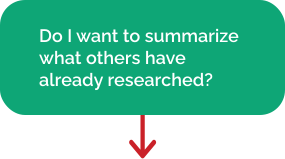
These papers don't collect new data. Instead, they read and summarize what others have already studied, and share what's missing or what can be improved.

Example: Reviewing different apps that help students with ADHD.

Comparative Studies

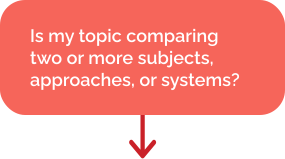
You compare two or more things—schools, cities, products, or ideas—to find similarities and differences.

Example: Comparing public transport in two cities or climate policies in two countries.

Critical Analysis

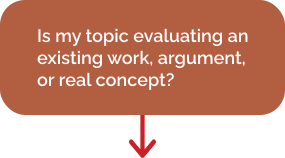
You take an existing idea, book, film, or event and deeply examine its strengths, weaknesses, and messages.

Example: Analyzing how social media influences climate awareness.

Social Impact Research

This research looks at real-life problems and how people or communities try to solve them.

Example: Studying how schools manage plastic waste or how students talk about mental health.

Innovation & Design Projects

Here you create or improve something—a design, a product, or a solution to a problem.

Example: Designing a new school app or making a prototype for a cleaner classroom.

Data Storytelling

You use numbers, charts, or visual tools to tell a story or explain a pattern.

Example: Showing how rainfall has changed in your city over the past 10 years.

Cultural & Heritage Exploration

You study local traditions, art, stories, or customs to understand and share your culture better.

Example: Recording your grandparents' stories or documenting a folk festival.

Multimedia Research

You explore topics using photos, videos, podcasts, or
sound.

Example: A short film on student life during exams or a podcast on local wildlife.

Speculative & Future Studies

This is about imagining the future using facts and creative
thinking.

Example: What will schools look like in 2050 ? How might climate change affect your town?

Perspectives & Opinions

You write about your views or experiences on a topic and support them with logic or research.

Example: Sharing your opinion on the importance of social media for learning.

Commentaries

You react to or comment on someone else's research, news story, or event.

Example: Writing a piece about a recent study on teen mental health and what you think about it.

Cross-Disciplinary Passion Projects

You combine two or more subjects that interest you—like art and science, or math and music—to explore something unique.

Example: How colors affect emotions, or how rhythm connects to heart rate.

Creative Writing Is About

Research is also creative. Your inquiry can inspire art and storytelling.

Creative writing is the art of using words to express ideas, emotions, and imagination in original ways. Unlike academic or technical writing, which focuses on facts and structure, creative writing allows you to explore your unique voice and creativity.

It can take many forms—stories, poems, plays, essays, or even experimental pieces. What makes it creative is not just the subject but how you write: your style, your choice of words, the worlds you create, and the feelings you bring alive.

Here, creative writing is not just about "being artistic."

Creative Writing
Fiction

Fiction

Step into your imagination and tell stories that move people. Build new worlds, invent characters, and share adventures only you could dream up.

You could write:

  • A short story about a robot who learns to paint
  • A play set in a future classroom
  • A fantasy tale about time-traveling scientists
Non-Fiction

Non-Fiction

Write about the real world—your thoughts, experiences, or things that matter to society. Share ideas that make others think or act.

You could write:

  • An essay about why students should learn climate science
  • A report on your school's clean energy project
  • A short biography of someone who inspires you
Poetry

Poetry

Play with rhythm, emotion, and words to capture how you see the world. Poems can be calm, loud, funny, or powerful—all they need is your voice.

You could write:

  • A poem about the sound of rain after exams
  • A shape poem about friendship
  • A free-verse reflection on growing up

Research is How the Future Begins.

Imagine better worlds, design new solutions, and tell stories that matter.
Wherever your curiosity leads, we'll help you share it.

Thumbs up Begin Your Journey with iNextResearcher

We are inclusive, affordable, and open for all students looking to make their mark in the research community. Don't wait, take the leap into publishing your work with us!